Construction
Where Construction Debris Actually Goes in Jefferson County
Understanding where the load actually goes is worth real money on a large job. Here is the Jefferson County chain, end to end.
The local disposal chain
Jefferson County's chain is unusually easy to follow, and worth knowing whether you are hauling yourself or just want to understand your invoice.
Material goes to the Jefferson County Transfer Station and Recycling Center at 27138 NYS Route 12, just north of Watertown. From there the county moves roughly 42,000 tons a year on to the Development Authority of the North Country landfill in the Town of Rodman.
DANC itself is a piece of local history worth knowing: it was created in 1985 specifically to build the infrastructure needed to support the reactivation of the 10th Mountain Division at Fort Drum. The landfill your renovation debris ends up in exists because of the post.
The county transfer station
Open to all county residents, and it accepts both construction and demolition debris and municipal solid waste.
- 27138 NYS Route 12, Watertown — (315) 786-6900
- Monday to Friday 7:30am to 3:00pm
- Saturday 7:30am to 1:00pm
- Bulky items $148 per ton. Bagged trash with prepaid $4.00 stickers
If you are bringing a mixed load, the order matters: weigh in first, unload the bulky items, then weigh out and pay before unloading the prepaid bags, which go inside Building #2. Get that sequence wrong and you go round again.
That $148 per ton is also the number to hold in your head when you are deciding whether to fill a container with something dense. Weight has a price here and it is not abstract.
The city bulk route, and why it does not scale
The City of Watertown does offer bulk collection that includes demolition and construction debris — but read the terms before you plan around it.
It is seasonal, running from early April through October as weather permits. It is on demand, so it has to be requested. It is priced per item. And for construction debris specifically, the published prices are estimates only, with a site visit possibly needed to calculate the final cost.
For one item, that is a perfectly reasonable service. For a renovation generating debris daily over three weeks, it is not a workable process — which is the gap a container fills.
Why stream separation saves money
Disposal is priced per ton and the rate varies by stream. Mixed construction and demolition debris is the most expensive category. Clean inert material is cheaper. Clean vegetation has its own route. Scrap metal has positive value.
Consider a demolition producing eight tons of broken concrete and eight tons of mixed debris. All in one container and you have sixteen tons at the mixed rate. Split it and eight of those tons move to a cheaper stream. Even after paying for a second container movement, the split usually wins.
It helps that source separation is already the local norm — Jefferson County recycles by separating materials rather than single stream, so nobody on a North Country site finds the idea strange.
The five streams worth separating
1. Clean concrete, block and stone
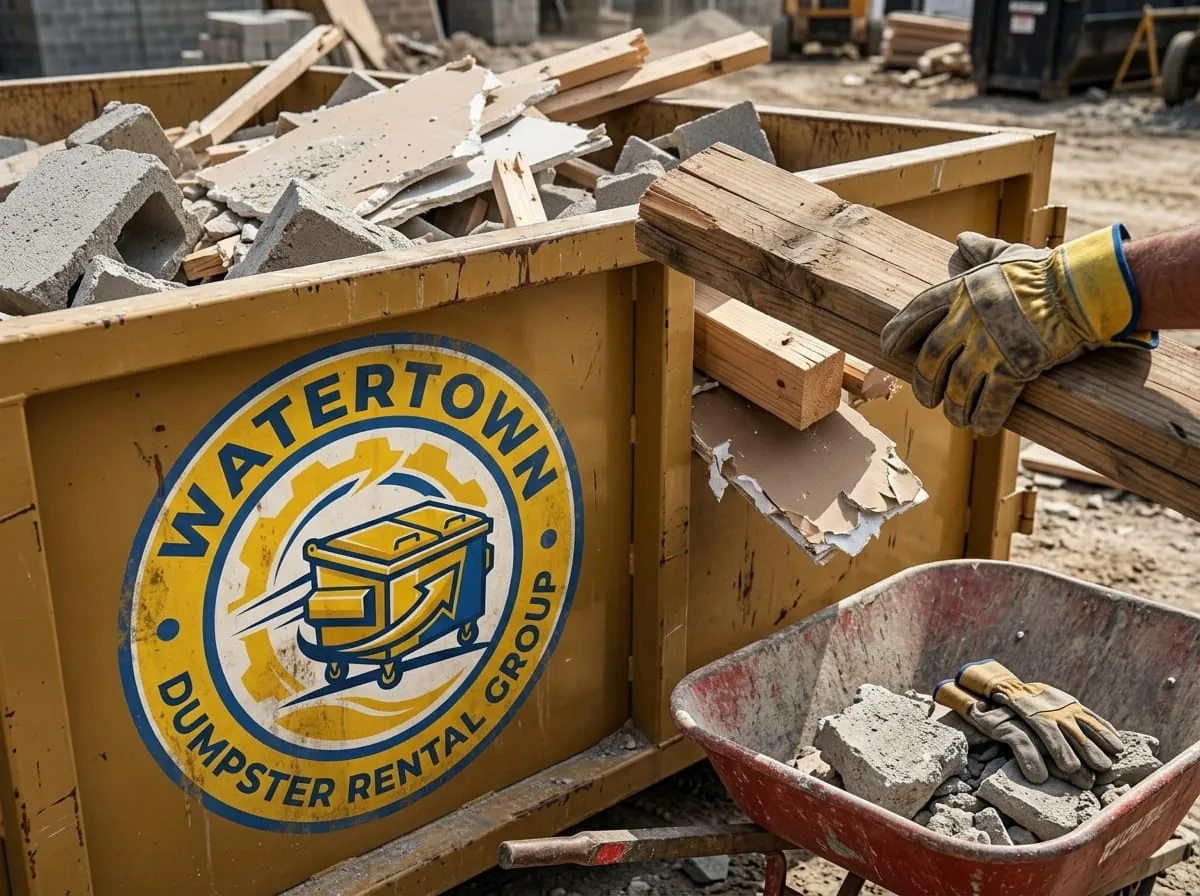
Rebar is generally fine. Timber, plastic sheeting, soil and general debris are not. Goes in a 10 yard because of weight, always.
2. Scrap metal
Copper pipe, steel studs, ductwork, conduit, rebar offcuts and appliances. Out in the county, barn roofing sheet, gates and old implements. On a farm demolition the metal alone is often worth setting aside.
3. Clean dimensional lumber
Untreated, unpainted, fasteners removed where practical. Treated timber does not qualify.
4. Cardboard and packaging
New construction generates an extraordinary amount, and cardboard is one of the separated recycling streams here anyway.
5. Clean vegetation
Site clearing. Keep it genuinely clean and it goes to a cheaper route. Soil is what usually ruins a vegetation load's economics.
Asbestos and pre-1980 buildings
This matters more here than in a newer market, because Jefferson County has a great deal of nineteenth and early twentieth century building stock — the village centres in Carthage, Brownville, Sackets Harbor and Watertown's own older neighbourhoods.
Any building from before roughly 1980 should be treated as asbestos-suspect until it has been surveyed. Floor tile and its mastic, pipe lagging, textured ceiling coatings and some siding products are the usual culprits. Abatement is licensed work with its own disposal route and it never goes in a roll-off container.
Get the survey done before demolition starts rather than discovering the problem halfway through a strip-out.
Sizing for construction debris
Framing, drywall, packaging and general build waste: go big. A 30 yard, with swap-outs planned into the programme. Bulky and light, so you fill the volume long before the weight allowance.
Concrete, stone, plaster and old village material: go small. A 10 yard, filled between half and two-thirds.
Most real jobs need both at different phases, which is why we would rather talk through the programme than take a single order.
Practical site setup
- Place containers where the work is, not where they are convenient for the truck. Labour spent walking debris across a site is the largest hidden cost in waste handling.
- Label them. A sheet of plywood marked CONCRETE ONLY prevents a great deal of expensive contamination.
- Brief the trades. One subcontractor throwing a lunch bag into the clean concrete container costs more than the briefing would have.
- Book swaps into the programme, not on the day you notice the can is full.
- In winter, keep it covered and keep the approach clear. A frozen load will not tip, and a truck that cannot reach the container is a wasted movement.
- Watch the spring thaw. When the frost comes out of the ground, site access routes that carried loaded trucks all winter will not carry them in April.
We are happy to help set that up — tell us the build programme and we will schedule around the trade sequence.
Need a container in Watertown?
Call and describe the job. Three minutes on the phone gets you a size recommendation, a flat rate and a delivery window — and we will tell you if a smaller, cheaper container is the right answer.
Call (315) 816-4682