
Practical
How to Stop a Dumpster Wrecking Your Driveway
A loaded roll-off puts several tons on four small steel contact points. Up here the driveway is only half the problem — the other half is what winter has done underneath it.
Why this matters here
The North Country is harder on driveways than almost anywhere, and for a reason that has nothing to do with the container.
Frost goes deep here. Water in the ground freezes, expands, lifts the slab or the asphalt above it, and then in spring the frost comes out and everything settles back down — but not evenly, and not always into the same shape. Do that every winter for twenty years and you get the cracked, heaved and hollow-under driveways that are completely normal across Jefferson County.
A driveway that looks sound in August may have a void under it that only appears when several tons sit on a small contact point.
How the damage actually happens
People picture the container's weight spread across its footprint. It is not. A roll-off sits on two steel rails and concentrates load at a small number of contact points — typically the rear wheels and the front of the rails.
A 20 yard loaded to four tons, plus the container's own weight, puts something in the order of several thousand pounds onto each of those points. Three mechanisms follow:
- Static load. The container sitting there over days, gradually pressing in.
- Dynamic load during delivery. The moment the container rolls off and the rear wheels touch down is the highest instantaneous load of the whole rental.
- Dragging. Winching the container back on drags the rails across the surface.
What protection boards do
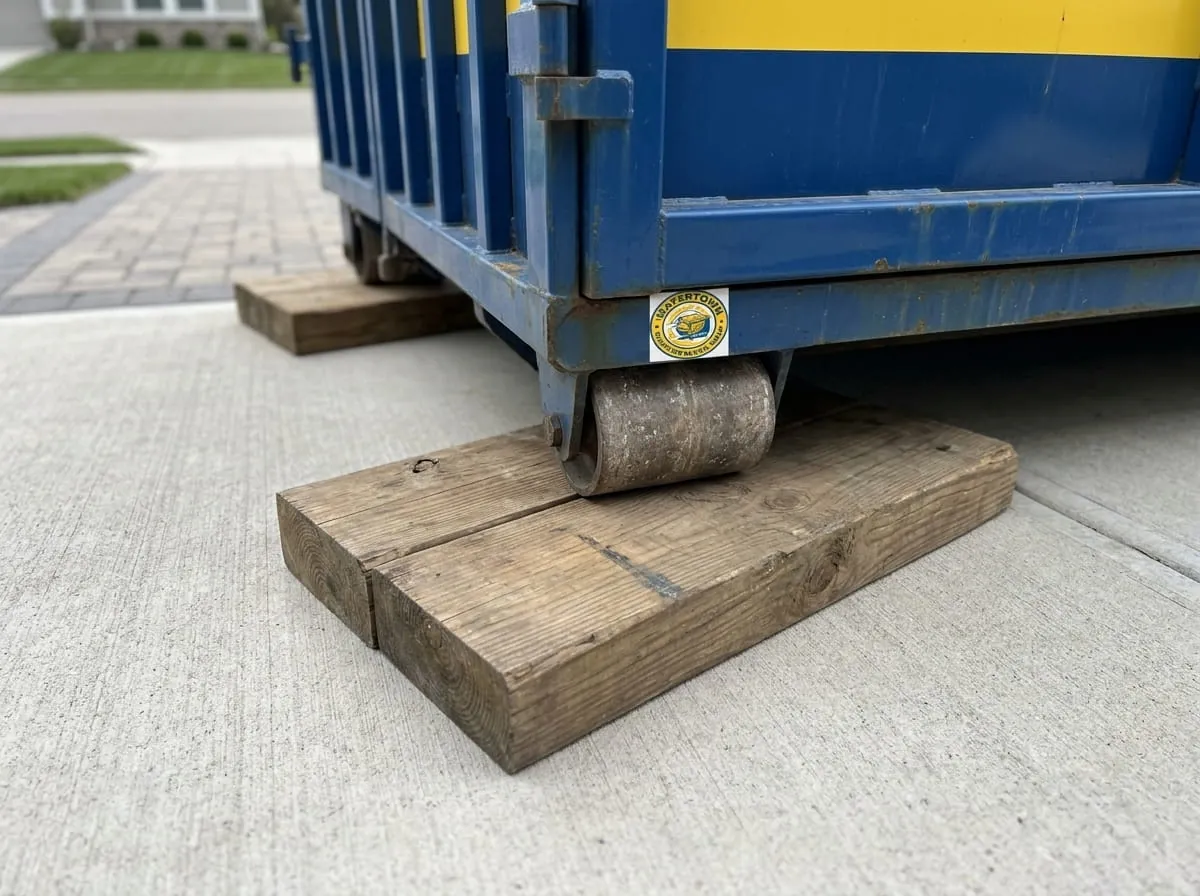
Plywood under the rails spreads a point load across a much larger area. It is unglamorous and extremely effective — the difference between several thousand pounds on four small contacts and the same weight distributed across several square feet.
Our drivers carry plywood on every truck as standard equipment. Boards go down before the container touches the surface, not afterwards, and again on collection because the drag-on is as damaging as the drop-off. On pavers and decorative concrete we double up.
Frost heave and what it leaves behind
Look at your driveway in late winter and you can often see it: a slab sitting slightly proud of where it was, a crack that has opened, an edge that has lifted. That is frost heave.
What matters for us is what it leaves behind after the thaw. A slab that has been lifted and dropped repeatedly can have voids underneath it — air where compacted base used to be — and a point load will find them. If you have visible cracking or a section that rocks slightly underfoot, point it out and we will place away from it.
The spring thaw is the dangerous season
If there is one thing to take from this page, it is this.
Frozen ground is genuinely strong. A placement that works perfectly in January can be the worst possible idea in early April, when the same ground has turned to porridge underneath a crust that still looks solid.
That is why we ask about timing on rural drives and lawn placements, and why we may suggest waiting a fortnight or placing at the road end instead. It is not caution for its own sake — it is the difference between a rutted lane and a recovery vehicle.
Surface by surface
Concrete driveway
Generally fine with boards down. Watch for frost cracking and lifted edges from previous winters.
Asphalt
Very common here and vulnerable at both ends of the year. It softens in summer heat and it becomes brittle in deep cold. Boards are essential either way.
Gravel and stone
Common on rural property and generally forgiving in summer. In spring it is the most vulnerable surface of all, because there is nothing spreading the load once the base softens.
Pavers and stamped concrete
Doubled boards as standard, and we lift rather than drag where possible.
Grass and bare ground
Fine when frozen hard or dry and firm. Never during the thaw.
What is underneath
Septic systems. Very common across rural Jefferson and Lewis Counties. Never place a container over a tank or lateral field.
Water wells. Also common on rural property. Keep clear of the wellhead.
Buried lines. Worth knowing where they run before several tons sit on them for a fortnight.
If something does go wrong
It is uncommon, but it happens. Tell us straight away rather than after the container is gone. Photograph it. We are licensed and insured, and where damage results from our placement we deal with it rather than arguing about it.
What we cannot take responsibility for is damage from a hazard nobody told us about — a septic tank we did not know was there, or a driveway already failed by frost that we were not shown.
The short version
- Boards go under the rails on every delivery. If a hauler does not do this as standard, use a different hauler.
- Tell us about frost cracking, lifted edges and anything that rocks underfoot.
- Be flexible about timing in the spring thaw — that is the risky season, not winter.
- Photograph existing damage before delivery.
- Know where your septic, well and buried lines run, and say so.
Need a container in Watertown?
Call and describe the job. Three minutes on the phone gets you a size recommendation, a flat rate and a delivery window — and we will tell you if a smaller, cheaper container is the right answer.
Call (315) 816-4682