
Winter
Renting a Dumpster Through a North Country Winter
Watertown takes some of the heaviest snow in the country, and winter is our busiest season for indoor work. Here is how to rent a container through it without problems.
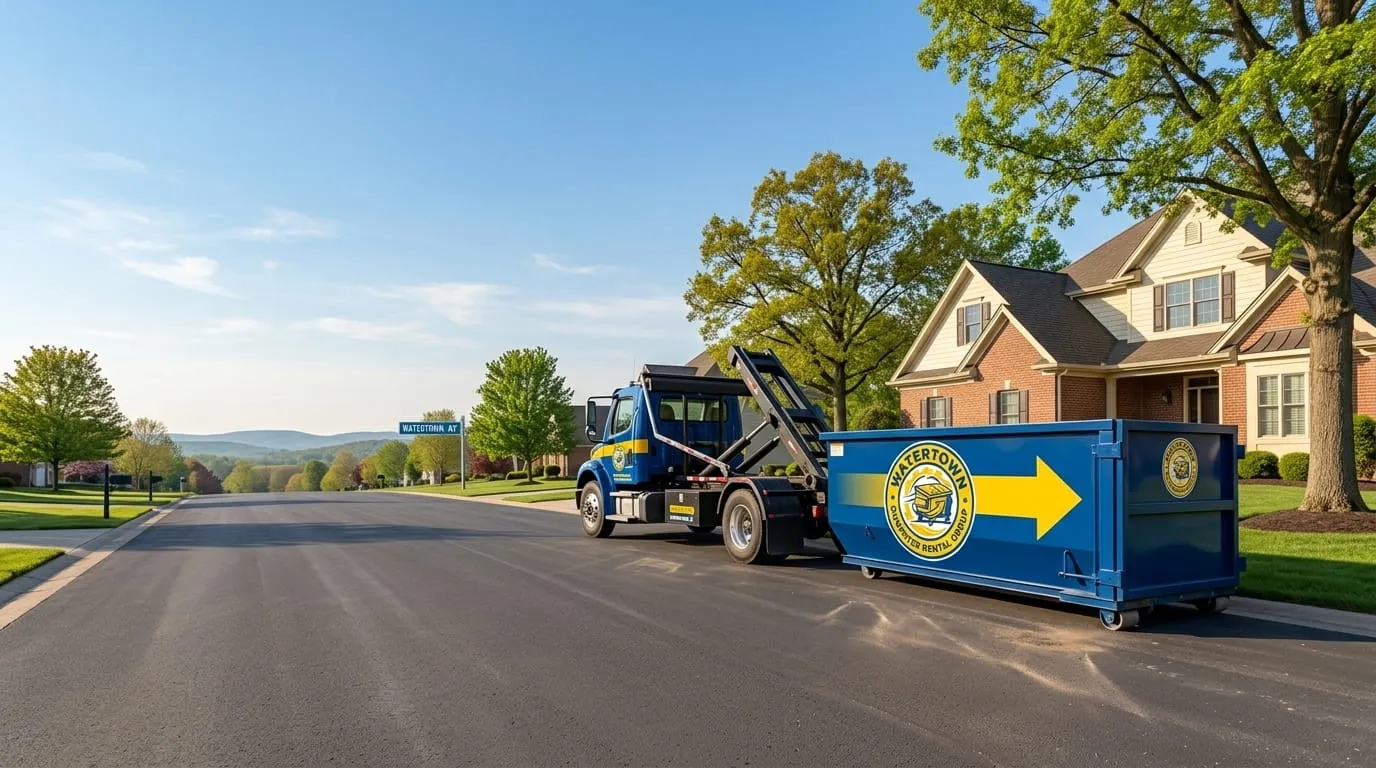
Yes, we deliver all winter
People ask, so: yes, we run all year. Winter is one of our busiest stretches, and not despite the weather but because of it. When it is dark at four and forty below with the wind, people finish basements, gut bathrooms, clear out cellars and empty houses. Interior work is winter work here.
What changes in winter is not whether we come but how the job has to be set up. Almost every winter problem we see is avoidable with a five-minute conversation at booking.
Why the city cannot help you until April
This is the fact that sends most of our winter calls.
So from roughly November to early April, if you have a sofa, a mattress, an old appliance or a cellar full of accumulated furniture, the city curbside service will not take it. The seasonal brush and green waste pickup is closed for the same period.
That leaves two options. The Jefferson County Transfer Station on NYS Route 12 is open year round — Monday to Friday 7:30am to 3:00pm, Saturday 7:30am to 1:00pm — and charges $148 per ton for bulky items. Or you rent a container.
For one chair, drive it up Route 12. For a cellar, a container is the answer, and that is exactly why our winter phone rings.
The frozen load, and how to avoid it
The single most common winter problem, and completely preventable.
If wet material goes into a container and then freezes, it bonds to the walls and the floor. When the truck lifts the container, the load does not slide out — it sits there, frozen in place. The container comes back to the yard still full, and it has to be thawed before it can be emptied.
How to avoid it:
- Cover the container. A tarp over the top through a storm is the whole solution. Snow that never gets in cannot melt and refreeze.
- Do not shovel snow into it. It is heavy, you pay for it by weight, and it is the main source of the water that freezes the load.
- Avoid loading soaked material — carpet, insulation, drywall from a leak — on top of a hard freeze, or at least get it collected before the next cold snap.
- Do not let it sit for weeks part-filled in January. Short rentals are better in deep winter.
Placement and the plow
In summer, placement is about surfaces and overhead clearance. In winter it is about two more things: whether the spot stays reachable, and whether it is in the plow's way.
Think about where the snow is going to be pushed. A container placed at the top of a driveway on a clear December day can be behind a four-foot bank by mid-January if that is where the plow throws it. Then neither you nor our truck can get to it.
The good placement is usually further down the drive than people expect, on the side away from the plow throw, with a clear approach for the truck. Tell us how your driveway gets cleared and we will work it out with you.
One more thing: keep the container's approach shovelled for collection day. A truck that cannot back in is a wasted movement, and we would rather reschedule than charge you a dry run.
Frozen ground is actually an advantage
Worth saying, because people assume winter is the risky season for their driveway. It is not.
Deeply frozen ground carries weight extremely well. A lawn placement that would rut badly in April will often take a loaded container in January without leaving a mark, and rural gravel drives are at their strongest when they are frozen solid.
The dangerous season here is the spring thaw, when the frost comes out and the base turns soft under a surface that still looks fine. If you have a rural drive or a lawn placement in mind, mid-winter is often a better bet than early April. More on that here.
Ice dams and the work they cause
Ice dams are the classic North Country winter failure. Heat escaping through the roof melts the underside of the snowpack; the water runs down to the cold eave and refreezes into a ridge; the ridge backs water up under the shingles and into the house.
The visible damage is a ceiling stain. The actual damage is usually much larger — soaked insulation, wet decking, ruined drywall, and sometimes mould by the time anyone opens it up.
The repair work is a winter and early spring staple for us, and it needs sizing carefully because saturated material is far heavier than its dry equivalent. A container that looks half full can already be at its weight allowance. Tell us it is water damage and we will size for weight.
What not to put in a winter container
- Snow and ice. Heavy, expensive and the cause of frozen loads.
- Wood or stove ash that is not completely cold. Days cold, not hours. A lot of households here heat with wood, embers stay live far longer than people expect, and a container fire is a serious event.
- Anything liquid that will freeze and split its container.
- Standing water in the bottom — if a container has taken rain before a freeze, say so and we will deal with it.
Booking through the season
A few practical points for winter bookings:
- Shorter rentals work better. A container that sits for three weeks in January accumulates snow and freezes. Book tighter and swap if you need to.
- Watch the forecast. If a major lake-effect event is coming, it is often better to take the collection a day early than to have the container buried.
- Tell us if the property is unheated or empty. Camps, rentals between tenants and estate properties all behave differently in winter, and we will plan the timing around it.
- Be realistic about our schedule during a storm. If the roads are closed, nobody is delivering. We will tell you honestly rather than promise a slot we cannot hold.
Call and describe the job. Winter here is a solved problem as long as it is planned rather than improvised.
Need a container in Watertown?
Call and describe the job. Three minutes on the phone gets you a size recommendation, a flat rate and a delivery window — and we will tell you if a smaller, cheaper container is the right answer.
Call (315) 816-4682